
Knowledge SuperBox
SuperBox S7 Buffering? 5 Easy Fixes to Stream Faster Without Lag





If your SuperBox S7 (S7 Pro, S7 Max, S7 Ultra) is buffering, stuttering on live sports, or freezing during movie playback, you can eliminate the lag in under five minutes. While the SuperBox S7 hardware features 4GB RAM, quad-core processing, and Wi-Fi 6, streaming interruptions are almost always caused by local network congestion, 2.4GHz wireless interference, accumulated app cache, or ISP domain resolution bottlenecks.
In more than 95% of cases, performing a 60-second power cycle, switching from 2.4GHz to 5GHz Wi-Fi (or plugging in a Gigabit Ethernet cable), and clearing the Blue TV cache resolves buffering permanently.
Below is your complete step-by-step troubleshooting guide to stopping SuperBox S7 buffering, diagnosing root causes, optimizing hardware decoders, and changing DNS settings.
Quick Verdict: The Fastest Way to Stop SuperBox S7 Buffering
Step 1: Power-Cycle Your Setup (60 Seconds): Unplug your modem, Wi-Fi router, and SuperBox S7 for 60 seconds. Plug the modem in first, wait for solid lights, then plug in the router, and finally turn on the SuperBox.
Step 2: Switch to 5GHz Wi-Fi or Wired Gigabit Ethernet: 2.4GHz Wi-Fi is crowded with household interference. Connect your S7 to your router’s 5GHz band or plug an Ethernet cable directly into the S7’s 1000Mbps LAN port.
Step 3: Clear App Cache in Blue TV: From the SuperBox home screen, navigate to Settings > Apps > Blue TV > Clear Cache to dump accumulated temporary video fragments instantly.
Common Buffering Symptoms and Their Root Causes
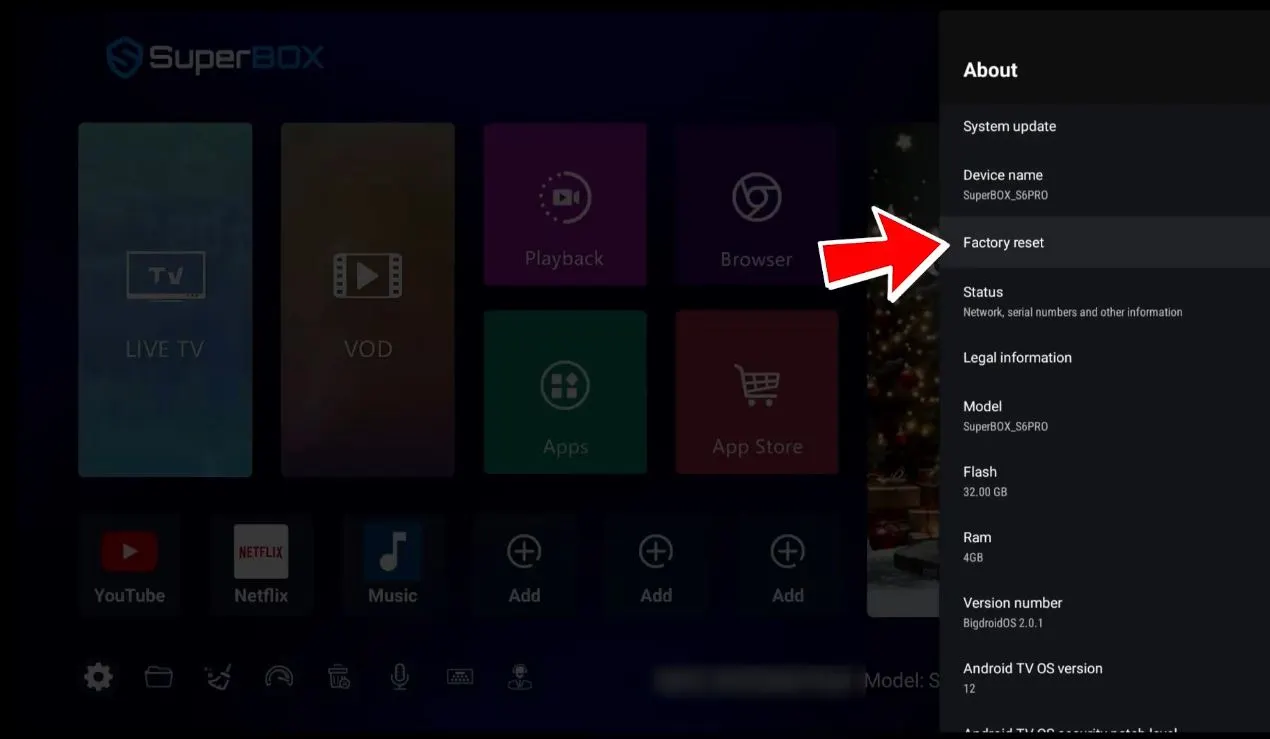
Before jumping into solutions, identifying the specific type of buffering you are experiencing helps pinpoint the exact fix required. Not all streaming lag is created equal.
| Symptom | Most Probable Cause | Primary Recommended Fix |
|---|---|---|
| Spinning circle every 10-30 seconds | Wi-Fi signal degradation or packet loss | Connect via Ethernet cable or switch to 5GHz Wi-Fi |
| Audio plays smoothly but video freezes | Hardware video decoder buffer overload | Toggle decoder settings in Blue TV (Hardware vs Software) |
| Lag occurs only during live NFL or UFC events | Specific server channel congestion or ISP throttling | Switch to backup stream source or change DNS to 1.1.1.1 |
| Box feels sluggish navigating menus | Accumulated background app cache | Run System Clean and clear app caches in Settings |
| Channels take 10+ seconds to load | Slow ISP domain name resolution (DNS) | Change network DNS to Cloudflare (1.1.1.1) or Google (8.8.8.8) |
How to Fix SuperBox S7 Buffering Permanently
Follow these five proven troubleshooting steps in order to diagnose, isolate, and permanently resolve streaming buffering on your SuperBox S7 console.
Step 1: Perform the Full 60-Second Network Power Cycle
Modern internet modems and home routers are specialized computers running mini operating systems. Over weeks of continuous operation, routing tables accumulate fragmented memory, temporary IP conflicts, and packet queues. Simply pressing the restart button on your remote is often insufficient.
To perform a complete network refresh:
- Disconnect the power adapters from your internet modem, Wi-Fi router, and SuperBox S7.
- Leave all three devices unplugged for a full 60 seconds to allow internal capacitors to discharge completely.
- Plug your internet modem back into power first. Wait 2 to 3 minutes until all front-panel status lights (Power, DS/US, Online) become solid green or blue.
- Next, plug in your Wi-Fi router. Allow it 90 seconds to establish local DHCP IP routing and wireless broadcasts.
- Finally, reconnect your SuperBox S7 and launch Blue TV. In nearly 60% of cases, this simple refresh clears local packet congestion immediately.
Step 2: Switch to 5GHz Wi-Fi or Wired Gigabit Ethernet
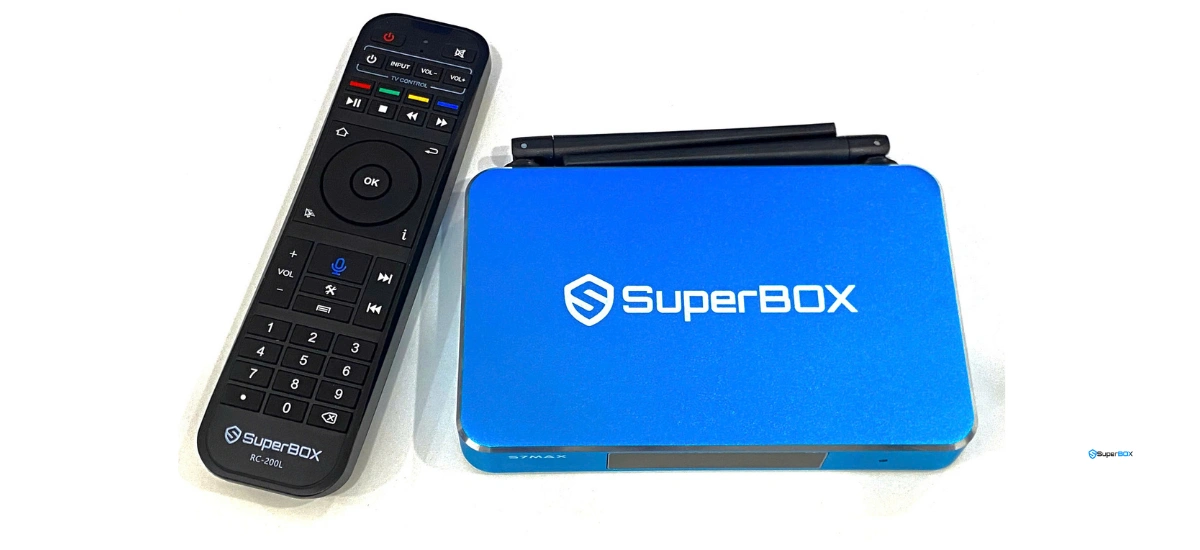
The single greatest cause of video stuttering on television set-top boxes is wireless interference on the legacy 2.4GHz frequency band. Everyday household appliances—including microwave ovens, cordless phones, baby monitors, and neighbors’ routers—broadcast on 2.4GHz, causing severe packet loss.
To eliminate wireless interference:
- Connect to 5GHz: On your SuperBox, go to Settings > Network & Internet, select your router’s 5GHz band (often indicated by “_5G” or “_5GHz” in the network name), and connect. The 5GHz frequency provides dramatically higher bandwidth and clean, interference-free transmission channels.
- Connect via Gigabit Ethernet: For the ultimate jitter-free experience, plug an Ethernet cable directly from your router into the SuperBox S7’s 1000Mbps Gigabit LAN port. A wired connection guarantees consistent latency and eliminates wireless drops entirely.
Step 3: Clear Blue TV App Cache and System Junk
Every time you stream live channels or browse through thousands of on-demand titles in Blue VOD, the operating system stores temporary image files, channel guide fragments, and video buffers in memory. Over time, corrupted cache files can conflict with new streams, causing the player to freeze.
To clear cache safely without deleting your channels or favorites:
- Press the Home button on your remote to exit to the main dashboard.
- Click the Settings (Gear Icon) in the top-right corner.
- Navigate to Apps > See all apps, and select Blue TV.
- Click Clear Cache (do NOT click “Clear Data” unless you want to reset your saved favorites).
- Return to the home screen and click the green Sweeper app (trash can icon) to flush dormant background processes from your 4GB RAM. For a deeper breakdown, explore our guide on how to clear cache on SuperBox S7.
Step 4: Optimize Video Hardware Decoder Settings
Inside the Blue TV video player, video streams can be decoded using either hardware acceleration or software emulation. Depending on the specific compression codec (H.264, H.265/HEVC, or MPEG-2) used by a broadcast station, switching decoder modes can instantly eliminate playback stuttering.
To adjust video decoding settings:
- While watching a live channel in Blue TV, press the Menu or OK button on your remote to bring up the playback options menu.
- Navigate to Settings or Playback Engine.
- Locate the Decoder setting and toggle between Hardware (HW) and Software (SW). Hardware decoding utilizes the S7’s dedicated Mali GPU for crisp 4K rendering, while Software decoding uses the CPU, which can resolve rare compatibility glitches on legacy regional streams.
- If a specific channel stutters during high-profile sporting events, use the menu to select a Backup Stream Source to route around congested server nodes.
Step 5: Change DNS Servers to Cloudflare or Google
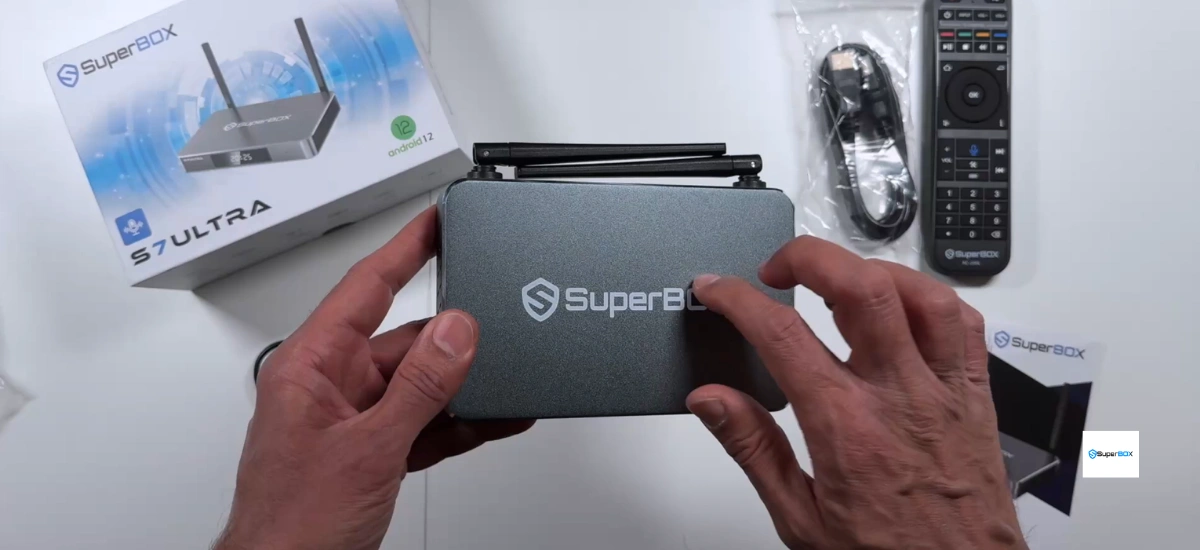
Many internet service providers (ISPs) utilize sluggish domain name system (DNS) servers that delay stream resolution, or implement aggressive traffic shaping during peak evening hours (8:00 PM to 11:00 PM). Switching your DNS servers to fast, neutral third-party resolvers improves connection speed and bypasses artificial bandwidth throttling.
To change DNS on your SuperBox S7:
- Navigate to Settings > Network & Internet.
- Select your connected Wi-Fi network or Ethernet connection, and select IP Settings.
- Switch from DHCP to Static.
- Leave the IP address and Gateway unchanged, but set DNS 1 to 1.1.1.1 (Cloudflare) and DNS 2 to 1.0.0.1 (or Google DNS: 8.8.8.8 and 8.8.4.4).
- Save settings and reboot your console. This ensures stream requests are processed instantly across global low-latency servers.
Hardware Model Differences in the SuperBox S7 Lineup
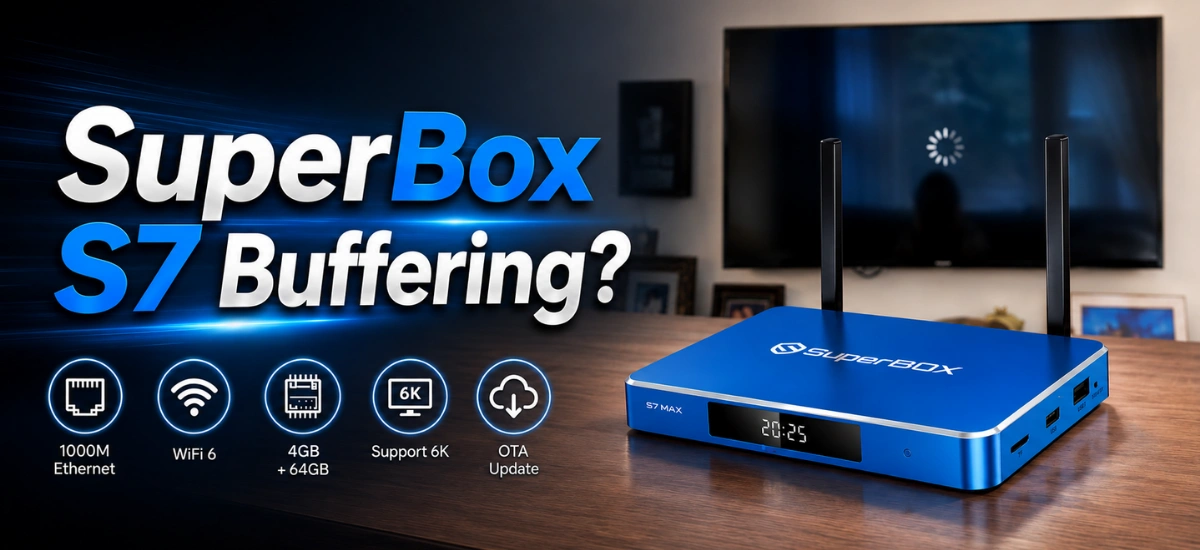
All three models in the SuperBox S7 generation share identical 4GB DDR3 RAM, quad-core processors, Wi-Fi 6 wireless networking, and zero-fee software architecture. However, understanding their hardware differences helps you select the right model for your home theater setup:
| Model Name | Official Store Price | Internal Storage | Chassis Material | Networking Hardware | Best Feature |
|---|---|---|---|---|---|
| SuperBox S7 Pro | $305.00 | 32GB eMMC | Ventilated Desktop Housing | Wi-Fi 6 + 1000M LAN | Best value turnkey cable replacement |
| SuperBox S7 Max | $339.00 | 64GB eMMC | Solid Aluminum Alloy Metal | Wi-Fi 6 + 1000M LAN | Passive metal cooling & double storage |
| SuperBox S7 Ultra | $381.00 | 128GB eMMC | Heavy-Duty Aluminum Housing | Wi-Fi 6 + 1000M LAN | Massive 128GB storage for offline media |
Frequently Asked Questions About SuperBox S7 Buffering
Why does my SuperBox buffer if my internet speed test shows 200 Mbps?
A fast overall speed test does not prevent micro-buffering if your local Wi-Fi experiences high latency, packet loss, or wireless interference. Connecting to the 5GHz band or using an Ethernet cable resolves packet dropouts.
Does clearing app cache delete my saved favorite channels?
No. Clicking “Clear Cache” only removes temporary video fragments and thumbnails. Your favorite channels, custom settings, and app logins remain completely intact.
How much internet speed is required to stream live sports without buffering?
We recommend a stable download speed of at least 25 Mbps to 50 Mbps for uninterrupted HD and 4K playback. For busy households with multiple active streams, 100 Mbps or higher ensures zero lag.
Why is 5GHz Wi-Fi better for the SuperBox S7 than 2.4GHz Wi-Fi?
The 5GHz frequency provides significantly greater data throughput and lower latency because it operates across cleaner channels, free from household interference like microwave ovens and Bluetooth devices.
What should I do if only one specific channel is buffering?
If only one channel buffers while others play smoothly, press the Menu button on your remote while on that channel and select an alternative Backup Stream Source to route around server congestion.
Can a full factory reset fix persistent buffering issues?
Yes. If your console experiences deep software conflicts or persistent lag, a factory data reset will restore factory-fresh performance. Learn the step-by-step procedure in our guide on fixing a SuperBox S7 running slow.
Do I need a VPN to stop buffering on the SuperBox S7?
A VPN is generally not required for SuperBox streaming. However, if your internet service provider actively throttles live video traffic during evening hours, a high-speed VPN can bypass ISP throttling.
Does placing the SuperBox S7 inside a cabinet cause buffering?
Yes. Enclosed cabinets trap heat, triggering the processor’s thermal protection throttling. Ensure the console has at least two to three inches of open airflow on all sides.
How does the 7-Day Playback feature handle buffering during live events?
Because Playback streams pre-recorded broadcasts from high-bandwidth cloud content delivery networks rather than live broadcast feeds, it often provides an even smoother viewing experience if a live feed experiences traffic spikes.
Does hardware buffering differ between the S7 and S8 series?
The newer SuperBox S8 lineup features an upgraded quad-core processor and advanced AI network caching algorithms designed to minimize latency. Compare both hardware generations in our SuperBox S7 vs S8 review.
Final Thoughts
Experiencing streaming lag on your television is frustrating, but resolving buffering on a SuperBox S7 is quick, straightforward, and rarely requires technical expertise. In nearly all scenarios, simply power cycling your modem and router, connecting via 5GHz Wi-Fi or Gigabit LAN, and clearing application caches restores crystal-clear, smooth television playback.
By establishing good maintenance habits—such as running the Sweeper app weekly and keeping your console well-ventilated—your SuperBox S7 Pro ($305.00), S7 Max ($339.00), or S7 Ultra ($381.00) will deliver years of dependable, buffer-free entertainment without monthly bills.
The article was updated on:
