
Knowledge SuperBox
7 Streaming Technology Trends Shaping 2026 and Beyond





Streaming has moved from being an alternative to television to becoming one of the main ways people use the television screen. The next phase is not defined by one dramatic jump from 4K to 6K or 8K. It is being shaped by a collection of practical improvements: more live programming, lower-cost ad-supported options, better video compression, faster content discovery, lower delay and hardware that can keep an older television useful for longer.
For viewers, however, the important question is not whether streaming will continue growing. It is which technologies will make a noticeable difference at home—and which futuristic specifications can safely be ignored for now.
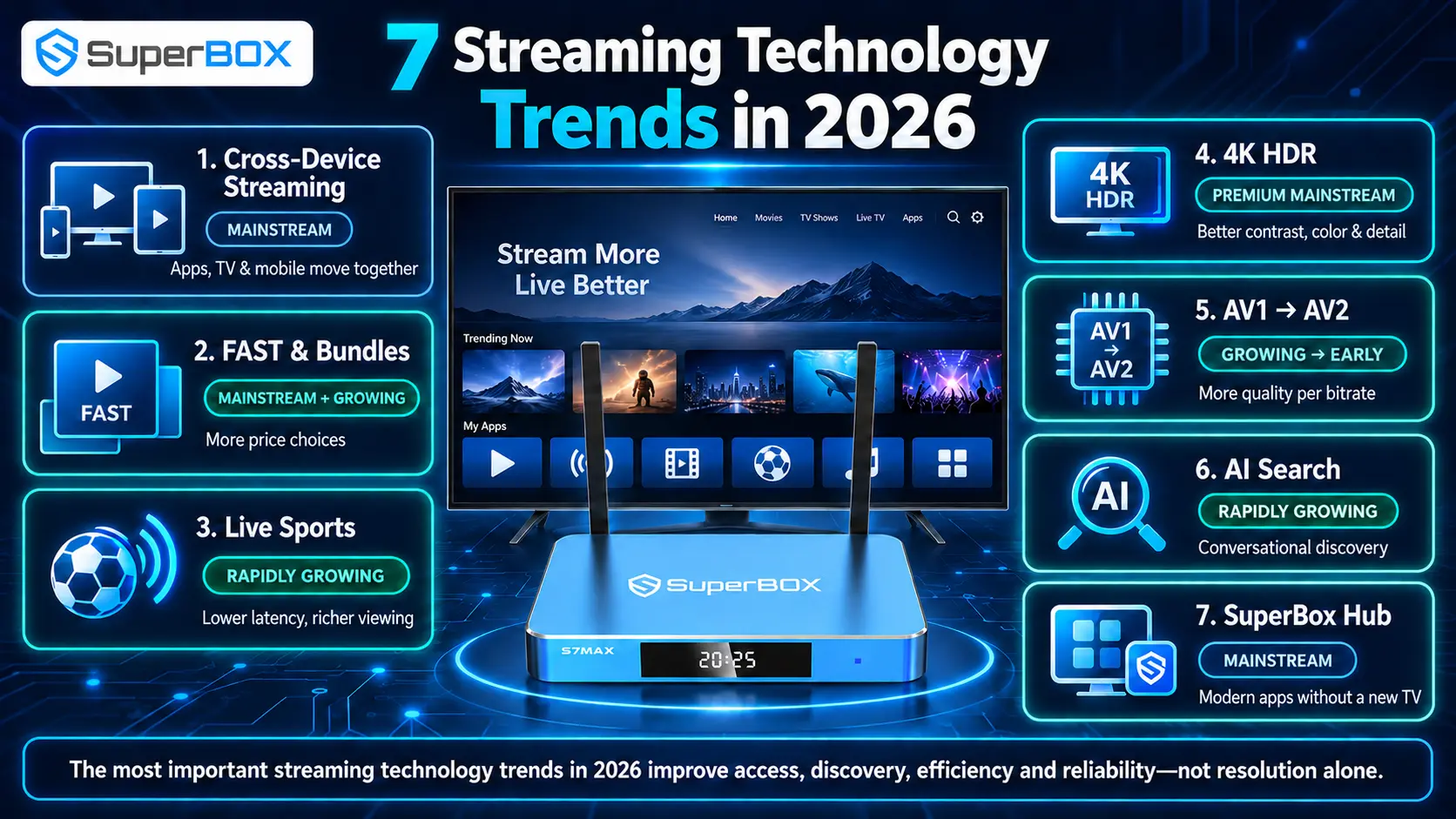
Streaming Technology Trends at a Glance
| Trend | Maturity in 2026 | What viewers will notice |
|---|---|---|
| Streaming becomes the default, cross-device TV experience | Mainstream | Viewing moves smoothly among apps, televisions and mobile devices |
| FAST, ad-supported plans and bundles expand | Mainstream and growing | More price choices and new ways to organize subscriptions |
| Live sports and low-latency delivery advance together | Rapidly growing | More live events with less delay and richer viewing options |
| 4K HDR improves while 8K remains niche | Mainstream for premium viewing | Better contrast, color and detail on compatible content and displays |
| AV1 adoption grows; AV2 begins its journey | AV1 growing; AV2 early | Better quality at a given bitrate as platforms and devices add support |
| AI changes search and recommendations | Rapidly growing | More conversational search and personalized discovery |
| SuperBox and upgradeable TV boxes become entertainment hubs | Mainstream | Modern apps, storage and connectivity without replacing the television |
1. Streaming Is Becoming the Default Television Experience
The most important streaming trend is also the easiest to overlook: streaming is no longer a separate activity that happens beside “normal TV.” For many households, it is the main interface through which television is discovered and watched.
The home screen, app launcher, search, recommendations and profiles now matter almost as much as the display. When built-in software begins to feel dated, an external player can refresh the media interface without replacing the television.
This is why the future of streaming is not simply “smart TVs replace TV boxes.” Smart TVs and external streamers increasingly serve different purposes: the television provides the screen, while the external device can provide a more flexible media interface.
Streaming also increasingly follows the viewer. A program may be discovered on a phone, started on a tablet and finished on a television. Cloud profiles, synchronized watchlists and playback history make that continuity possible within supported services.
At the same time, social and creator video is moving from phones onto the largest screen in the home. The living-room television is no longer reserved for traditional networks and studio-produced catalogs, so its interface must accommodate long-form shows, live events, short video, casting, voice control and household profiles.
2. FAST, Ad-Supported Plans and Streaming Bundles Expand
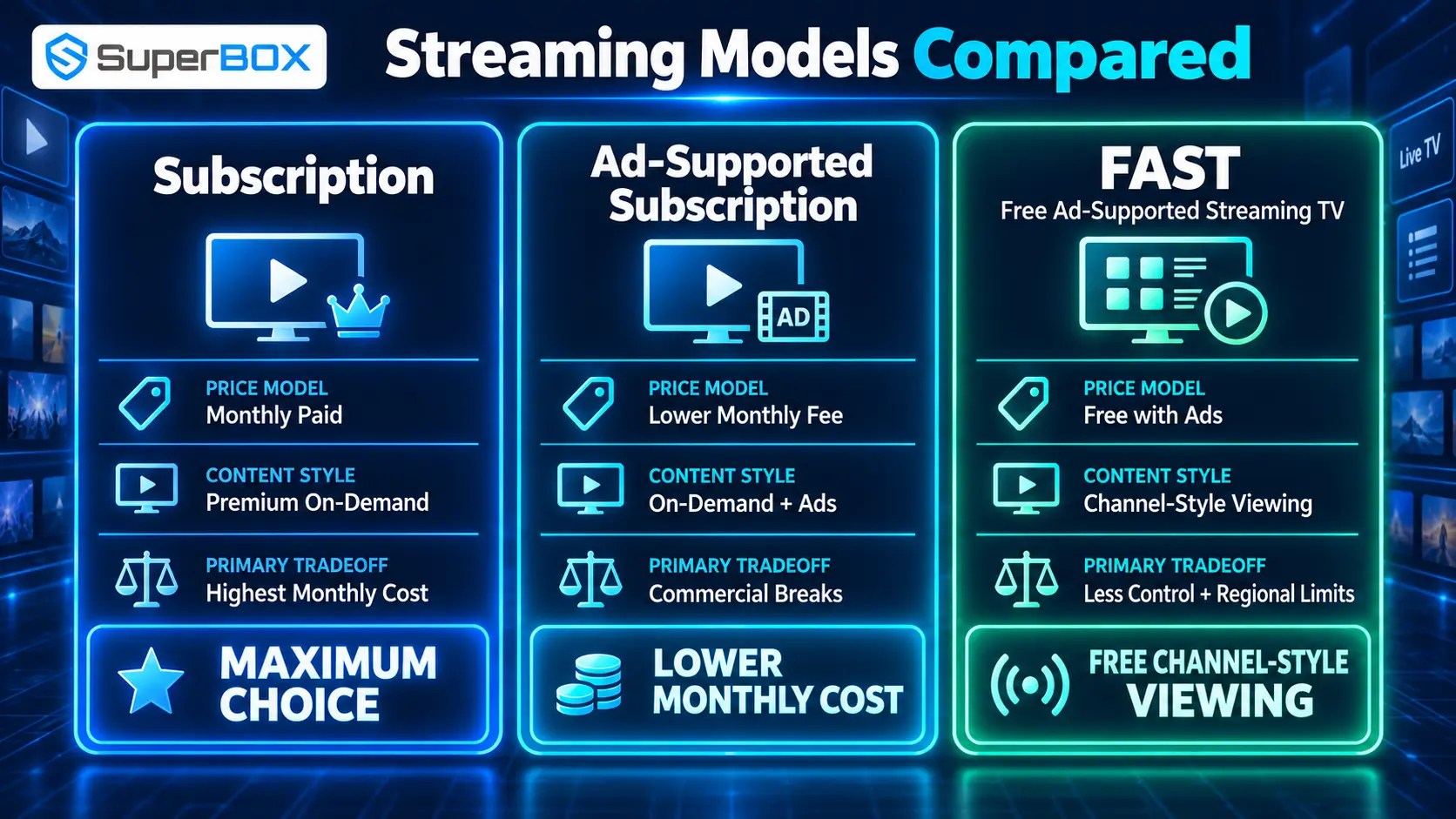
Subscription fatigue has changed the value equation. Viewers still want premium subscription services, but many are also adding free ad-supported streaming television, commonly called FAST, and lower-priced subscription tiers that include commercials.
FAST combines internet delivery with a familiar channel-style guide, allowing viewers to join programming already in progress instead of choosing every title individually.
Nielsen and Gracenote reporting both show that free ad-supported services are becoming a meaningful part of television viewing, with continued expansion across entertainment, news and sports programming.
Lower cost generally means more advertising, so viewers should also compare catalog depth, picture quality, device support and regional availability.
At the same time, streaming bundles and aggregation are returning. As exclusive catalogs multiplied, viewers ended up managing more apps, passwords, renewal dates and bills. Bundles combine services under one price or billing relationship, while aggregation interfaces help users search across compatible catalogs. Deloitte’s Digital Media Trends research has documented consumer frustration with managing multiple subscriptions and rising prices, helping explain why simpler packaging has returned.
Neither approach automatically saves money. Keep frequently used services, rotate seasonal subscriptions and compare bundles against what you would actually purchase separately.
What this trend means for viewers
- Expect paid, ad-supported and free services to coexist rather than one model replacing the others.
- A flexible streaming setup should make it easy to move among multiple legitimate apps.
- “Free” describes the price, not an absence of tradeoffs; advertising and data collection may help fund the service.
- Availability varies by country, platform and licensing agreement.
3. Live Sports and Low-Latency Streaming Advance Together
On-demand libraries built the streaming economy, but live sports is becoming one of its strongest engines for sign-ups and engagement. Major services increasingly use live games, combat sports, racing, tournaments and supporting programs to differentiate themselves.
Gracenote’s 2026 catalog research shows that major subscription services are expanding sports programming aggressively. This does not mean every game is available to every viewer, because rights remain divided by service, league and region.
Live sports exposes weaknesses that are less obvious during movies. Viewers notice startup time, picture degradation, dropped frames and delay immediately when a decisive play is happening now.
That is pushing investment in several areas at once:
- Lower-latency delivery protocols
- More efficient encoding
- Better content delivery networks
- Faster switching between quality levels
- More dependable home Wi-Fi and wired networking
- Multi-view, alternate commentary and real-time statistics
Sports rights remain fragmented and regional. No streaming device creates rights that an app or provider does not possess. Before purchasing a subscription or hardware specifically for a league, viewers should confirm the official provider, location restrictions and supported-device list.
Latency—the time between an event occurring and appearing on screen—is becoming a consumer-facing feature. Technologies such as Apple’s Low-Latency HLS can reduce delay, although the final result still depends on production, distribution, the app, internet connection and playback hardware. Home equipment cannot remove upstream delay, but a responsive device and stable connection can avoid adding unnecessary stalls.
4. 4K HDR Matters More Than the Race to 6K or 8K
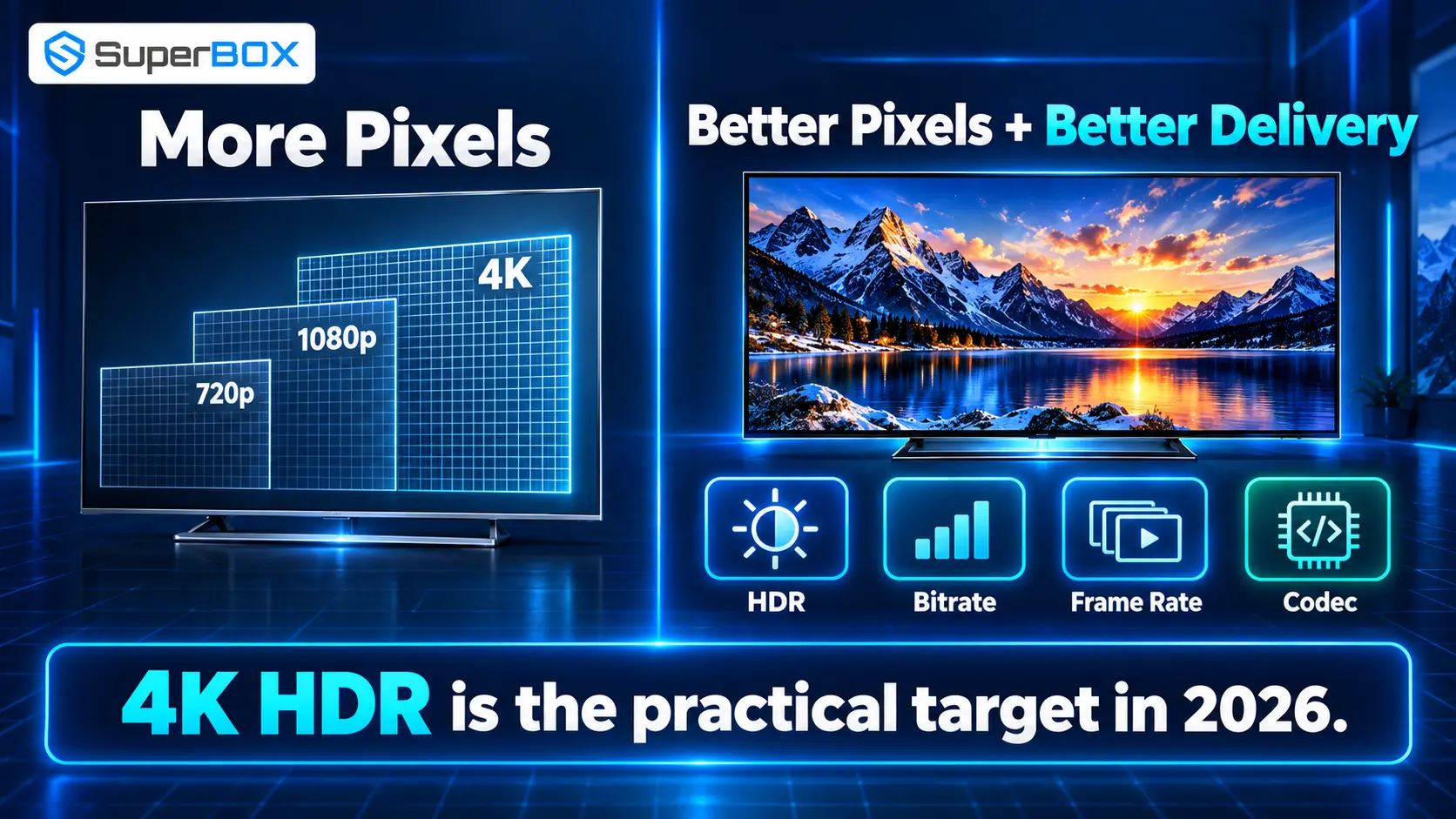
Resolution still matters, but the market conversation has become more mature. 4K is the practical high-resolution target for mainstream premium streaming in 2026. The next improvements viewers are most likely to appreciate come from better HDR, wider color, stronger contrast, higher-quality source masters and more consistent bitrate—not simply a larger number printed on a product page.
On compatible, well-mastered content, HDR’s brighter highlights, richer color and improved shadow detail may be more visible than resolution beyond 4K at a normal viewing distance.
Native 8K streaming remains limited and requires the entire chain to be compatible. A “6K capable” or “8K capable” specification does not mean mainstream services provide their catalogs at that resolution.
Resolution versus the complete picture
| Specification | What it changes | Why it is not enough by itself |
|---|---|---|
| Resolution | Number of pixels in the image | Source quality, screen size and viewing distance affect visible benefit |
| HDR | Range between dark and bright image areas | TV capability, format support and mastering quality must align |
| Frame rate | Motion smoothness | Content and app must provide the appropriate frame rate |
| Bitrate | Amount of video data delivered over time | Efficiency depends on codec and encoder quality |
| Codec | How video is compressed and decoded | Both the service and playback device need compatible support |
The sensible buying priority is compatibility and stability: a good 4K television, correct display settings, capable playback hardware and a dependable connection. Chasing 6K or 8K before those basics are solved rarely produces the best return.
5. AV1 Grows While AV2 Starts the Next Codec Cycle
Video codecs work behind the scenes. Greater efficiency can deliver similar quality with less data or better quality at a comparable bitrate.
AV1 is the important consumer-facing codec trend today. The Alliance for Open Media describes it as an open codec optimized for high-resolution video, adaptive streaming and HDR. Support has expanded across platforms, encoders and newer playback hardware, although it is not universal.
The Alliance for Open Media released the AV2 specification in 2026. It matters for the long term, but a specification release begins an adoption cycle; it does not mean current televisions and streaming boxes already decode AV2.
For a buyer today, AV1 support can be useful. AV2 should be watched rather than treated as an immediate requirement. The same principle applies to any emerging codec: platform adoption, hardware decoding, power efficiency and real content availability matter more than a logo on a spec sheet.
6. AI Moves From Recommendation Rows to Conversational Discovery
Recommendation systems have used machine learning for years. The newer shift is toward interfaces that understand natural-language requests and combine discovery with action.
Instead of searching only by title, a viewer may describe a mood, topic, audience or team. The system can use content metadata and account context to narrow the results.
Google previewed expanded Gemini experiences for Google TV in 2026, illustrating how television interfaces are moving toward more conversational interaction. Across the industry, AI is also being applied to subtitling, dubbing workflows, advertising, thumbnails, content tagging, compression decisions and customer support.
Deloitte’s 2026 outlook likewise emphasizes engagement, audience intelligence and speed of innovation. Competition is not only about owning more titles, but helping viewers find something relevant quickly.
The benefits come with important limits:
- A recommendation may be personalized without being accurate.
- Results are limited by the services and catalogs the interface can search.
- Voice and viewing data raise privacy questions.
- Generative summaries can make mistakes.
- Different household members still need separate profiles for useful personalization.
The best AI television feature is not the one that produces the longest answer. It is the one that reduces the time between deciding what to watch and pressing Play, while providing clear privacy controls.
7. SuperBox and Upgradeable TV Boxes Become Home Entertainment Hubs
The delivery platform can invest in codecs and content delivery networks, but the final few feet still belong to the home. Congested Wi-Fi, an overloaded router, poor device placement or aging playback hardware can undermine an otherwise excellent service.
That makes connectivity an increasingly important streaming-device specification. Wi-Fi 6 can improve performance in compatible networks with multiple connected devices. Gigabit Ethernet offers a wired option where running a cable is practical. Neither automatically increases the bitrate provided by a service, but both can help create a more reliable path between the internet connection and the player.
Storage and memory also affect the daily experience. More internal storage provides room for compatible apps and updates, while sufficient memory helps the interface remain responsive during multitasking. USB connectivity can support local media and compatible accessories, subject to the device and application.
Upgradeable external hardware offers another advantage: it separates the replacement cycle of the display from the replacement cycle of the streaming interface. A good television can remain in service while the connected player is changed as software, codecs and connectivity evolve.
SuperBox represents this shift from a basic plug-in player toward a more capable home entertainment hub. It upgrades a television through HDMI, giving viewers a dedicated Android-based interface, its own memory and storage, multiple network options, USB connectivity and a purpose-built remote without requiring them to replace a screen that still looks good.
The competitive advantages of SuperBox
It upgrades the entertainment system without replacing the TV
A television panel and its built-in smart software do not age at the same rate. The screen may remain excellent while the internal interface becomes slow, short on storage or less convenient. A SuperBox lets the user refresh the media side independently, which can be more economical and less wasteful than purchasing a new television only for newer smart features.
It combines wireless and wired connectivity
Current premium models such as the SuperBox S7 Max provide dual-band Wi-Fi 6 as well as Gigabit Ethernet. Wi-Fi offers placement flexibility; Ethernet gives users a wired alternative when the router is nearby or the wireless environment is crowded. This choice is especially valuable for live television and sports, where an unstable final connection is more noticeable.
It offers more room for apps and local media workflows
The S7 Max combines 4GB of memory with 64GB of eMMC storage. That provides space for compatible apps, updates and user files while supporting smoother navigation and multitasking than a severely storage-constrained television interface. USB 3.0 also makes it possible to connect compatible storage for local media use. Exact app, file-system and accessory compatibility should always be confirmed before purchase.
It is designed for everyday television control
A streaming experience is only as convenient as the interface used every evening. The S7 Max includes a backlit voice remote, making common controls easier to see in a dark room and allowing supported voice functions to reduce on-screen typing. The redesigned interface, favorites and viewing tools aim to shorten the route from turning on the TV to finding something to watch.
It supports a flexible mix of entertainment apps
Rather than locking the television experience to one subscription provider, an Android-based box can serve as a common launch point for multiple compatible applications. User can reach to library full of content through apps designed for SuperBox.
It adds viewing features beyond basic app launching
Supported SuperBox services can include features such as voice navigation, parental controls and Time Shift for eligible programming. These tools fit the broader streaming trend toward flexible viewing: the experience becomes less dependent on being in front of the television at the exact moment a supported program airs. Time Shift availability is not universal and should not be described as built-in DVR recording.
It has an independent upgrade cycle and portable form factor
Because the box connects through HDMI, it can be replaced or moved independently of the television. This can extend the useful life of an older display and makes the setup practical for another room, an RV or travel where a compatible television and reliable internet connection are available.
SuperBox advantages – and what they actually mean
| SuperBox capability | Competitive advantage | Important limitation |
|---|---|---|
| External HDMI platform | Modernizes a usable TV without replacing the display | Picture quality remains limited by the source and television |
| Wi-Fi 6 plus Gigabit Ethernet on S7 Max | Gives users both flexible wireless and stable wired options | Cannot repair problems with the internet provider or source server |
| 4GB memory and 64GB storage on S7 Max | Provides useful room for compatible apps and smoother multitasking | Available storage and app compatibility can vary |
| Remote | Improves navigation and nighttime usability | Voice functions depend on correct setup and supported software |
| USB 3.0 | Supports compatible external storage and local media | Not every drive, file format or peripheral is guaranteed |
| Time Shift on supported programming | Adds schedule flexibility beyond basic live viewing | It is not universal manual or scheduled DVR recording |
| One-time purchase | No recurring fee merely to own the device and apps specific designed for SuperBox | Third-party services may charge separate subscription fees |
| Independent device lifecycle | Lets owners upgrade the player separately from the TV | Future app and format support can never be guaranteed indefinitely |
SuperBox therefore competes most effectively on flexibility, connectivity and convenience. What it can do is give the viewer a capable, upgradeable control center and access to large library of media contents for the parts of the home-entertainment experience that happen inside the home.
The SuperBox S7 Max is listed at $399 by SuperBox TV Box Store at the time of this September 2026 update. Because prices and model availability can change, the live product page should remain the final reference before publication or purchase.
What These Trends Mean for Streaming Device Buyers
Specification lists mix useful features with impressive numbers that may have little effect on daily viewing. Use this priority order:
| Priority | What to check |
|---|---|
| Compatibility | Legitimate apps, media formats, regional availability and account requirements |
| Picture output | Dependable 4K and appropriate HDR support before theoretical higher resolutions |
| Networking | Current dual-band Wi-Fi and Ethernet when a wired setup is practical |
| Hardware | Balanced processor, memory, storage and cooling rather than one headline number |
| Daily control | Clear interface, useful shortcuts, voice functions and remote visibility |
| Seller support | Verifiable product information, setup help, warranty and return terms |
Which Streaming Trends Should You Act On Now?
| Priority | Act now | Watch for later |
|---|---|---|
| Video quality | Optimize 4K HDR compatibility and settings | Wider native 8K availability |
| Codec | Prefer capable modern hardware; AV1 is useful | AV2 device and service adoption |
| Content cost | Compare ad-supported plans, FAST and bundles | New interactive advertising formats |
| Live viewing | Prioritize a stable connection and supported apps | Broader multi-view and interactive sports |
| Discovery | Use voice search, watchlists and cross-service tools | More reliable conversational AI agents |
| Hardware | Choose sufficient memory, storage and networking | Replace only when new capabilities have real content support |
The pattern is simple: invest in technologies that improve what you watch today, and monitor technologies that still need an ecosystem to form around them.
Frequently Asked Questions
What is the biggest streaming technology trend in 2026?
The largest overall shift is streaming becoming a primary form of television viewing rather than a secondary alternative. Within the market, FAST services, ad-supported plans and live sports are among the fastest-moving consumer trends.
Is 8K streaming mainstream in 2026?
No. 8K displays and demonstration content exist, but mainstream native 8K streaming remains limited. For most buyers, strong 4K HDR performance is a more useful priority.
What is FAST streaming?
FAST means free ad-supported streaming television. It generally provides free viewing funded by advertising, often through scheduled channel-style streams, on-demand catalogs or a combination of both.
Why is live sports important to streaming services?
Live sports can attract new subscribers and create appointment viewing. It also encourages platforms to improve latency, reliability, alternate feeds and real-time features.
What is AV1 streaming?
AV1 is an open video codec designed for efficient, high-quality compression. When supported by the service and playback hardware, it can help deliver better quality at a given bitrate or comparable quality using less data.
Does low latency prevent buffering?
Not necessarily. Latency describes delay from the live event to the screen; buffering occurs when playback does not receive or process media reliably enough. A stream can have low delay yet still buffer on an unstable connection.
How is AI changing television streaming?
AI is improving recommendations, natural-language search, content metadata, localization, advertising and production workflows. Its usefulness depends on accuracy, catalog access and privacy controls.
Will streaming bundles become cable packages again?
Bundles are returning because viewers want simpler billing and better value. They may resemble parts of traditional television packaging, but most still offer more flexibility to subscribe, cancel or rotate services.
Does SuperBox require a separate internet connection?
Online streaming functions require internet access. The SuperBox does not include home internet service; it connects through the household network using Wi-Fi or Ethernet on supported models.
Final Thoughts: The Future of Streaming Is Practical, Not Just Futuristic
The defining streaming technologies of 2026 do not all produce a dramatic new resolution badge. They make video easier to find, less expensive to access, more efficient to deliver and more reliable to watch live.
FAST channels and ad-supported plans are widening the range of price points. Live sports is accelerating investment in low latency and reliability. AV1 is improving compression today while AV2 begins a longer adoption cycle. AI is changing discovery, and aggregation is trying to solve the complexity created by too many separate services.
For viewers, the best response is not to replace every device whenever a new term appears. Build around a strong 4K HDR display, dependable networking, legitimate services and playback hardware that can be upgraded independently. That approach delivers value now while leaving room for the streaming ecosystem to evolve.
To explore an external media player designed around flexible connectivity and home-entertainment use, see the SuperBox S7 Max. For help comparing models or confirming compatibility, contact SuperBox TV Box Store.
The article was updated on:
