
Knowledge SuperBox S8
SuperBox S8 Max vs. S8 Pro: Comprehensive Hardware, Price, and Performance Comparison





As the cord-cutting movement matures, television viewers increasingly demand hardware that combines broadcast reliability, rapid channel tuning, and expansive local application storage. The SuperBox S8 generation represents the manufacturer’s most refined hardware cycle to date, elevating network stability, system responsiveness, and industrial design. However, prospective buyers frequently debate whether to choose the entry flagship SuperBox S8 Pro or invest the additional $40 to step up to the SuperBox S8 Max. In this architectural breakdown, we examine internal components, thermals, storage limits, and daily user experience to help you select the ideal model for your living room.
Comprehensive Specifications: SuperBox S8 Max vs. SuperBox S8 Pro
Both models in the S8 series share a high-performance system-on-chip (SoC) foundation, but deviate significantly in chassis thermal dissipation and onboard storage capacity. The table below outlines the core hardware specifications of both flagship streaming units side by side:
| Hardware Specification | SuperBox S8 Pro | SuperBox S8 Max | Architectural Advantage |
|---|---|---|---|
| Retail MSRP Pricing | $359.00 (One-time) | $399.00 (One-time) | $40 difference for upgraded chassis & double flash |
| Processor (CPU) | Quad-Core 64-bit ARM Cortex | Quad-Core 64-bit ARM Cortex | Identical clock speed and multi-threaded throughput |
| System Memory (RAM) | 4GB DDR4 High-Bandwidth | 4GB DDR4 High-Bandwidth | Identical buffer handling and app switching speed |
| Internal Storage (ROM) | 32GB eMMC 5.1 | 64GB eMMC 5.1 | S8 Max provides 2x capacity for apps and recordings |
| Chassis Build Material | Engineered Matte ABS Composite | Aviation-Grade Aluminum Alloy | S8 Max delivers superior passive thermal conductivity |
| Wireless Connectivity | Wi-Fi 6 (802.11ax) Dual-Band 2.4/5G | Wi-Fi 6 (802.11ax) Dual-Band 2.4/5G | Identical dual external high-gain antenna arrays |
| Wired Network LAN | 1000M Gigabit RJ45 Ethernet | 1000M Gigabit RJ45 Ethernet | Zero-jitter wired data transfer on both devices |
| Operating System | Android 12 + Blue OS Engine | Android 12 + Blue OS Engine | Identical clean launcher with Google Play support |
| Voice Control Technology | AI Voice Engine + RC-200L Remote | AI Voice Engine + RC-200L Remote | Backlit Bluetooth remote with voice search on both |
| Catch-Up & DVR Features | 7-Day Time Shift Playback + TV Recorder | 7-Day Time Shift Playback + TV Recorder | Cloud-based 168-hour continuous program rewind |
Architectural Deep Dive: Storage, Thermals, and Usability
While surface specifications may look similar on a spec sheet, real-world living room demands expose why the hardware differences between the S8 Pro and S8 Max matter over multi-year ownership.
1. Storage Capacity: 32GB vs. 64GB eMMC 5.1
On an Android 12 set-top box, system firmware, OS core partitions, and pre-installed system applications occupy approximately 9GB to 11GB of raw storage. On the SuperBox S8 Pro (32GB), this leaves roughly 21GB to 23GB of usable user space for third-party APKs, Kodi builds, application caching, and offline media. While 21GB is more than adequate for streaming enthusiasts who primarily utilize Blue TV and Blue VOD, heavy power users who sideload retro gaming emulators, offline video files, or large Plex databases can exhaust 32GB over time.
On the SuperBox S8 Max (64GB), users receive over 53GB of accessible storage. This generous headroom accommodates dozens of third-party streaming apps, IPTV players, high-definition games, and cached stream buffers without ever triggering low-storage system warnings or sluggish application load times.
2. Thermal Engineering: Aluminum Alloy vs. Matte Composite
Continuous decoding of high-bitrate 4K 60fps video streams, dynamic HEVC/H.265 compression, and live HLS stream de-packetizing generates substantial internal thermal energy within the SoC. The SuperBox S8 Pro utilizes a lightweight, durable ABS composite housing with bottom ventilation slits. In contrast, the SuperBox S8 Max features an extruded aluminum alloy outer chassis that functions as an integrated passive heatsink.
Aluminum exhibits a thermal conductivity rating over 200 times higher than plastic composites. By pulling heat away from the quad-core processor and DDR4 memory modules directly to the exterior surface, the S8 Max maintains lower junction temperatures during all-day live sports broadcasts, eliminating thermal throttling, video stutter, or unexpected system reboots.
| Evaluation Metric | SuperBox S8 Pro ($359.00) | SuperBox S8 Max ($399.00) | User Experience Impact |
|---|---|---|---|
| Usable App Storage Space | ~21GB – 23GB free | ~52GB – 54GB free | S8 Max supports heavier app libraries & Kodi builds |
| Operating Temperature (6-hr load) | 48°C – 53°C (Normal) | 39°C – 44°C (Cooler) | Aluminum chassis lowers SoC temp by ~8°C – 10°C |
| Chassis Durability & Feel | Matte impact-resistant ABS | CNC machined aluminum alloy | S8 Max provides premium aesthetic and weight |
| Long-Term Value Retention | High cord-cutting ROI | Maximum longevity & resale | $40 upgrade pays off over 3 to 5 years of daily use |
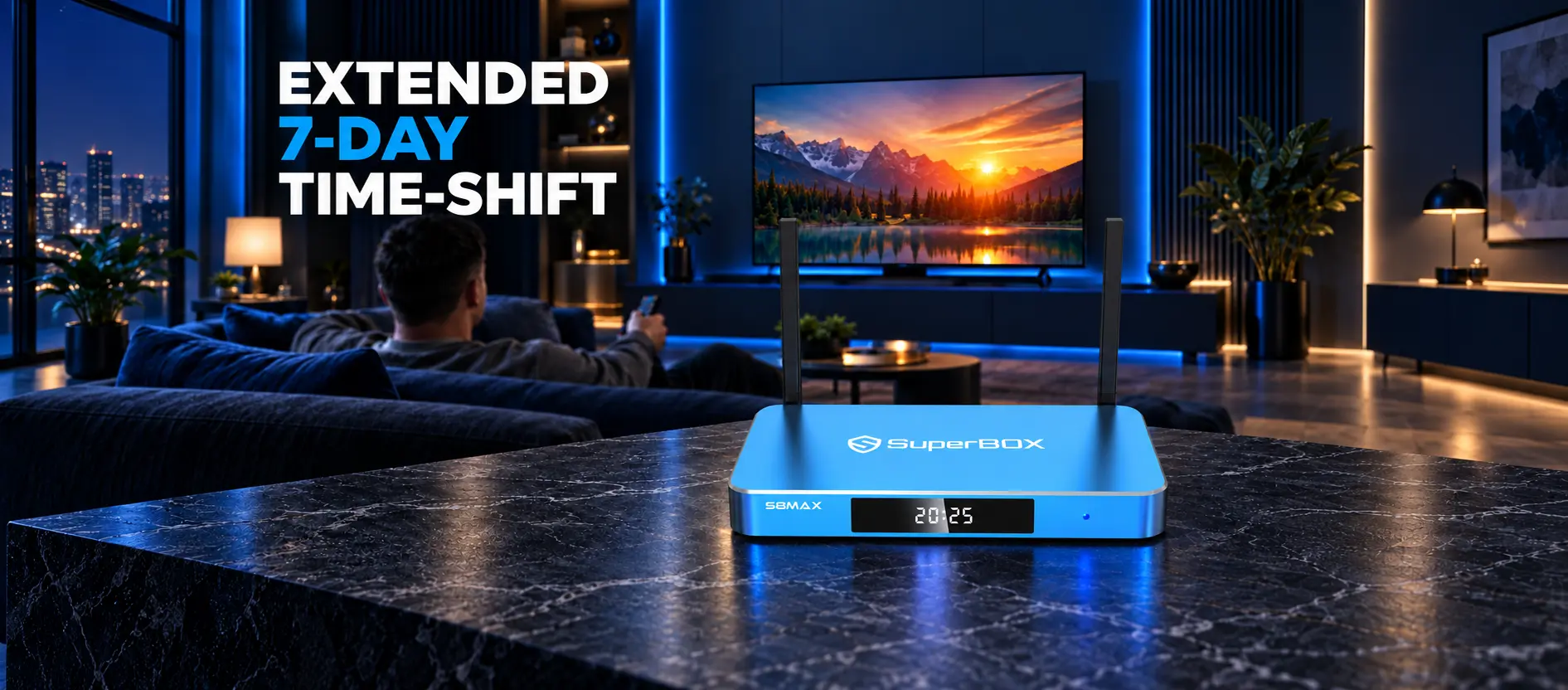
Shared Flagship Capabilities: Wi-Fi 6, 1000M LAN & Blue OS
Beyond their physical housing and storage configurations, the S8 Pro and S8 Max share the identical cutting-edge networking and software ecosystem that defines the S8 generation:
- Wi-Fi 6 (802.11ax) Connectivity: Both models integrate state-of-the-art Wi-Fi 6 transceivers paired with dual external omnidirectional antennas. This setup dramatically cuts packet latency, improves multi-device congestion management in busy households, and provides sustained wireless throughput exceeding 600 Mbps.
- 1000M Gigabit Ethernet: For uncompromising stability, both units feature a true Gigabit LAN port, enabling latency-free wired data transfers directly from your network router.
- AI Voice Search Remote: The included RC-200L backlit Bluetooth remote features dedicated voice recognition. Users can speak naturally into the remote to search by team name, movie title, actor, or channel number without cumbersome on-screen typing.
- 7-Day Time Shift Playback & TV Recorder: Both models grant full access to 168 hours of continuous cloud-archived television broadcasts and support the dedicated TV Recorder app for local program scheduling.
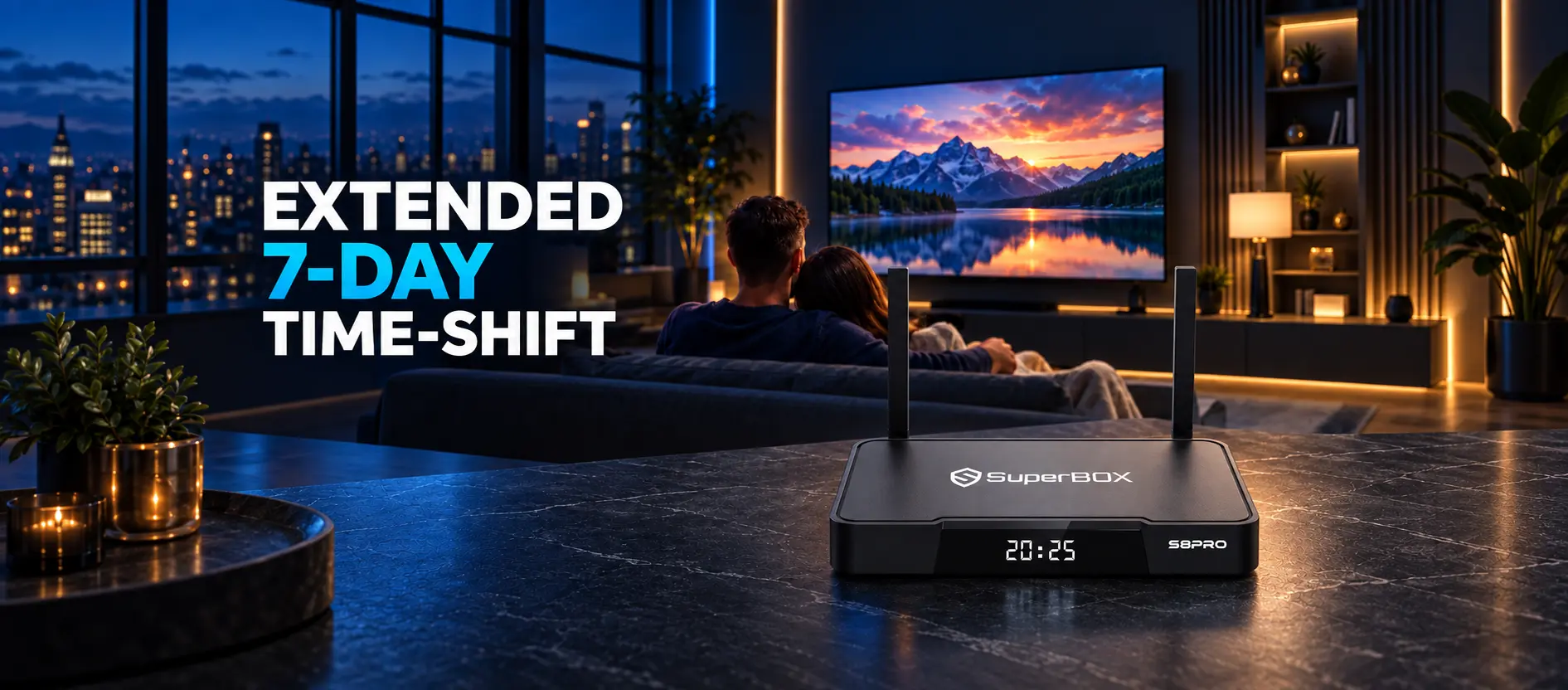
Step-by-Step Guide: Setting Up and Optimizing the SuperBox S8 Series
Whether you choose the S8 Pro or S8 Max, follow our step-by-step setup procedure to extract peak 4K performance from your new streaming hardware:
Step 1: Unbox Unit and Verify Authentic Serial Barcodes
Inspect the bottom label of your S8 unit to confirm the serial barcode and factory security sticker match the packaging box. Genuine SuperBox devices come tied directly to authorized cloud server endpoints.
Step 2: Connect HDMI to an HDCP 2.2 Compatible 4K TV Port
Connect the included high-speed HDMI cable from the S8 HDMI output directly to an HDMI 2.0/2.1 port on your 4K display. Plug the 5V power adapter into a wall outlet or surge protector and power on the box.
Step 3: Connect to High-Speed Wi-Fi 6 or 1000M Gigabit Ethernet
Navigate to Network Settings. For optimal stability, plug in a Cat6 Gigabit Ethernet cable. If connecting wirelessly, select your router’s 5GHz Wi-Fi 6 SSID and ensure the dual external antennas are positioned vertically for maximum signal gain.
Step 4: Pair Backlit Bluetooth Remote and Calibrate Voice Commands
Hold the [Home] and [OK] buttons on the RC-200L remote until the indicator flashes blue. Once paired via Bluetooth, press the microphone button to test voice commands such as “Open Blue TV” or “Find action movies.”
Step 5: Launch SuperBox App Store and Download Blue TV and Blue VOD
From the home dashboard, open the SuperBox App Store. Download and install the latest versions of Blue TV, Blue VOD, Playback, and the Backup utility. Allow all requested storage permissions.
Step 6: Optimize Video Decoding, Aspect Ratio, and Buffer Settings
Open Blue TV, press the Menu button on your remote, and navigate to Playback Settings. Set the decoder to Hardware Plus (HW+), choose your preferred aspect ratio (Original or 16:9 Fit), and set Buffer Size to Medium for instantaneous channel transitions.
Step 7: Configure Regional EPG Time Zone and Favorite Channels
Within Blue TV and Playback settings, set your exact local time zone (e.g., Eastern, Central, or Pacific Time). This aligns the Electronic Program Guide (EPG) with live programming schedules. Long-press OK on your most-watched channels to add them to your instant Favorites category.
Frequently Asked Questions
1. What is the primary difference between SuperBox S8 Max and S8 Pro?
The primary differences are internal storage and chassis material. The SuperBox S8 Max ($399.00) features 64GB eMMC storage and an aviation-grade aluminum alloy enclosure for enhanced passive cooling. The SuperBox S8 Pro ($359.00) includes 32GB storage encased in a durable ABS composite housing. Both share identical processors, 4GB RAM, Wi-Fi 6, 1000M LAN, and live channel access.
2. Does the aluminum alloy casing on the S8 Max make a noticeable difference?
Yes, particularly during heavy usage. Aluminum dissipates heat over 200 times more efficiently than plastic. During continuous 6- to 8-hour live 4K broadcasts or intense multi-app multitasking, the S8 Max runs approximately 8°C to 10°C cooler than composite enclosures, preserving long-term component lifespan and preventing thermal throttling.
3. Are the streaming channels and content libraries identical on both S8 models?
Yes. Both the S8 Pro and S8 Max connect to the exact same dedicated cloud server clusters. Both units deliver identical access to live sports, news, entertainment, pay-per-view events, international channels, and on-demand movie libraries through Blue TV and Blue VOD without monthly subscription fees.
4. Can I expand the internal storage of the S8 Pro using a USB flash drive or microSD?
Yes. Both the S8 Pro and S8 Max feature USB ports and a microSD card expansion slot. You can format external USB 3.0 drives or microSD cards as portable storage or adopt them as device storage for media files and recordings. However, onboard eMMC 5.1 flash storage runs faster than external USB drives for core application execution.
5. Do both the S8 Max and S8 Pro support Wi-Fi 6 and 1000M Gigabit LAN?
Yes. Both models are equipped with full Wi-Fi 6 (802.11ax) dual-band transceivers, dual external high-gain omnidirectional antennas, and a dedicated 1000M RJ45 Gigabit Ethernet port, ensuring maximum throughput and minimal latency regardless of your connection method.
6. How does the AI Voice Engine work on the S8 series remote?
The included RC-200L backlit Bluetooth remote features an integrated voice microphone. When you press the voice button and speak, the AI Voice Engine parses natural language commands to search across live channels, video-on-demand titles, and system settings, instantly taking you to your desired program without manual typing.
7. Does the S8 series require any monthly or annual subscription fees?
No. Both the SuperBox S8 Max and S8 Pro require only a one-time hardware purchase. All live channels, sports packages, video-on-demand movies, and 7-day playback features are fully accessible without monthly subscription bills, contracts, or renewal fees.
8. Can I record live television on the SuperBox S8 Max and S8 Pro?
Yes. In addition to the automated 7-Day Time Shift Playback feature (which archives broadcasts on cloud servers for 168 hours), both models support the dedicated TV Recorder app. The S8 Max’s larger 64GB storage provides substantially more room for saving scheduled local recordings directly on the box.
9. Which model is better if I plan to use the box for gaming and heavy sideloading?
The SuperBox S8 Max ($399.00) is the superior choice for gamers and power users. With 64GB of fast internal storage, you can sideload retro gaming emulators, large game ROMs, custom Kodi builds, and multiple streaming APKs without worrying about running out of system memory.
10. Is the extra $40 for the SuperBox S8 Max worth the upgrade over the S8 Pro?
Yes. For most cord-cutters planning to use their TV box daily over the next 3 to 5 years, the $40 difference ($399.00 vs. $359.00) is highly justified. Doubling your onboard storage to 64GB and gaining an aviation-grade aluminum passive heatsink ensures cooler operation, superior longevity, and greater future-proofing.
The article was updated on:
